
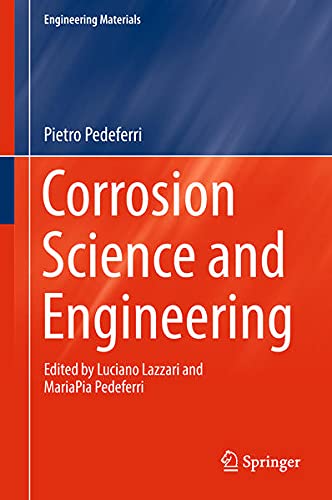
Corrosion Science and Engineering / by Pietro Pedeferri.
Material type: TextLanguage: English Series: Engineering MaterialsPublisher: Cham : Springer International Publishing : Imprint: Springer, 2018Edition: 1st ed. 2018Description: XXIX, 720 pages : illustrations; 24 cmContent type:
 - text
- computer
- online resource
- 9783319976259
- 23 620.11223 PEC 2018
 Books
Books
| Cover image | Item type | Current library | Home library | Collection | Shelving location | Call number | Materials specified | Vol info | URL | Copy number | Status | Notes | Date due | Barcode | Item holds | Item hold queue priority | Course reserves | |
|---|---|---|---|---|---|---|---|---|---|---|---|---|---|---|---|---|---|---|
|
Books
|
Central Library, University of Rajshahi Reading Room | Non-fiction | 620.11223 PEC 2018 (Browse shelf(Opens below)) | C-1 | Not For Loan | BDT | B58951 | |||||||||||
|
Books
|
Central Library, University of Rajshahi General Stacks | Non-fiction | 620.11223 PEC 2018 (Browse shelf(Opens below)) | C-2 | Available | BDT | B58950 |
General principles of corrosion -- Electrochemical mechanism -- Thermodynamics of aqueous corrosion -- Pourbaix diagrams -- Kinetics of aqueous corrosion -- Evans Diagrams -- Corrosion factors -- Uniform Corrosion in Acidic and Aerated Solutions -- Macrocell corrosion mechanism -- Galvanic corrosion -- Pitting corrosion -- Crevice Corrosion -- Stress Corrosion Cracking and Corrosion-Fatigue -- Hydrogen-Induced Damage -- Intergranular and Selective Corrosion -- Erosion-Corrosion and Fretting -- Corrosion prevention by coatings -- Environmental Control -- Cathodic and anodic protection -- Corrosion in waters -- Corrosion in soil -- Atmospheric corrosion -- Corrosion in concrete -- Corrosion in petrochemical plant -- Corrosion in the human body -- High temperature corrosion -- Prevention of corrosion in design -- Monitoring and inspections -- Testing -- Statistical analysis of corrosion data.
This textbook discusses the latest advances in the corrosion of metals and related protection methods, and explores all corrosion-related aspects used in natural and industrial environments, including monitoring and testing. Throughout the textbook, the science and engineering of corrosion are merged to help readers perform correct corrosion assessments in both the design phase and plant management phase, and to define the optimal protection technique. In addition, the book addresses basic aspects of corrosion science, including the electrochemical mechanism, thermodynamic and kinetic aspects, the use of Pourbaix and Evans diagrams, and various forms of corrosion (from uniform to localised to stress corrosion phenomena); as well as the protection systems adopted to combat corrosion, including inhibitors, coatings and cathodic protection. Such basic knowledge is fundamental to understanding the "corrosion engineering" approach applied to the durability of metals immersed in water, buried in soil, exposed to the atmosphere, used in reinforced concrete, in the human body and in petrochemical plants, or at risk of high-temperature corrosion. A final chapter is dedicated to the use of statistics in corrosion. All chapters include exercises and practical examples to help students understand, predict, evaluate and mitigate corrosion problems. As such, the book offers the ideal learning resource for all students of corrosion courses in chemical, mechanical, energy and materials engineering at the graduate and advanced undergraduate level, as well as a valuable reference guide for engineers whose work involves real-world applications.
Description based on publisher-supplied MARC data.
There are no comments on this title.