
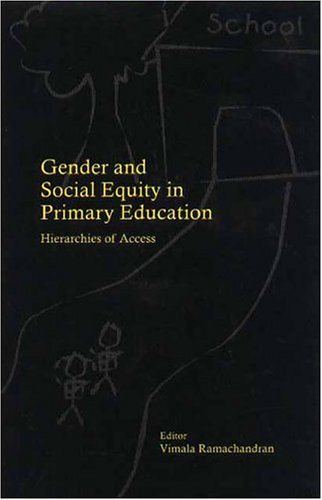
Gender and social equity in primary education : hierarchies of access / edited by Vimala Ramachandran.
Material type: TextLanguage: English Publication details: New Delhi ; London : Sage, 2004.Description: 381 p. ; 23 cmISBN:
 - 076193247X (cased)
- 0761932488 (pbk.)
- 817829382X (India)
- 8178293838 (India pbk.)
- 372.0954 23 GEN 2004
 Books
Books
| Cover image | Item type | Current library | Home library | Collection | Shelving location | Call number | Materials specified | Vol info | URL | Copy number | Status | Notes | Date due | Barcode | Item holds | Item hold queue priority | Course reserves | |
|---|---|---|---|---|---|---|---|---|---|---|---|---|---|---|---|---|---|---|
|
Books
|
Central Library, University of Rajshahi Reading Room | Non-fiction | 372.0954 GEN 2004 (Browse shelf(Opens below)) | C-1 | Not For Loan | INR | B22279 |
Includes bibliographical references and index.
"This volume provides an insightful understanding of the ground realities of primary education programmes, particularly those run by the District Primary Education Programme (DPEP). Combining secondary research with field studies conducted in six states, the contributors explore gender and social equity issues in primary education. They conclude that there is a subtle but nevertheless discernible 'hierarchy of access' to education, which has resulted in new forms of segregation in primary schools." "The findings indicate that a child's gender, caste, class and community tend to define the nature of the school he or she attends which, in turn, has implications for the processes of teaching and learning. The field studies also explore the perceptions of parents, teachers, children and the community regarding primary schooling and the impact of the DPEP. The volume additionally elaborates on the institutional mechanisms and strategies required to improve schooling and reduce inequalities, as also assesses the efficacy of various non-formal and alternative education initiatives." "Capturing the texture and nuances of primary education through qualitative investigations, this volume is unique in drawing attention to the new segregation in basic education. It will be widely welcomed by educationists and sociologists and will be equally useful to policymakers, administrators, teachers and NGOs engaged in education."--BOOK JACKET.
There are no comments on this title.